CAS – Meteor Observation – Edward Cooper (CAS UKMON Coordinator)
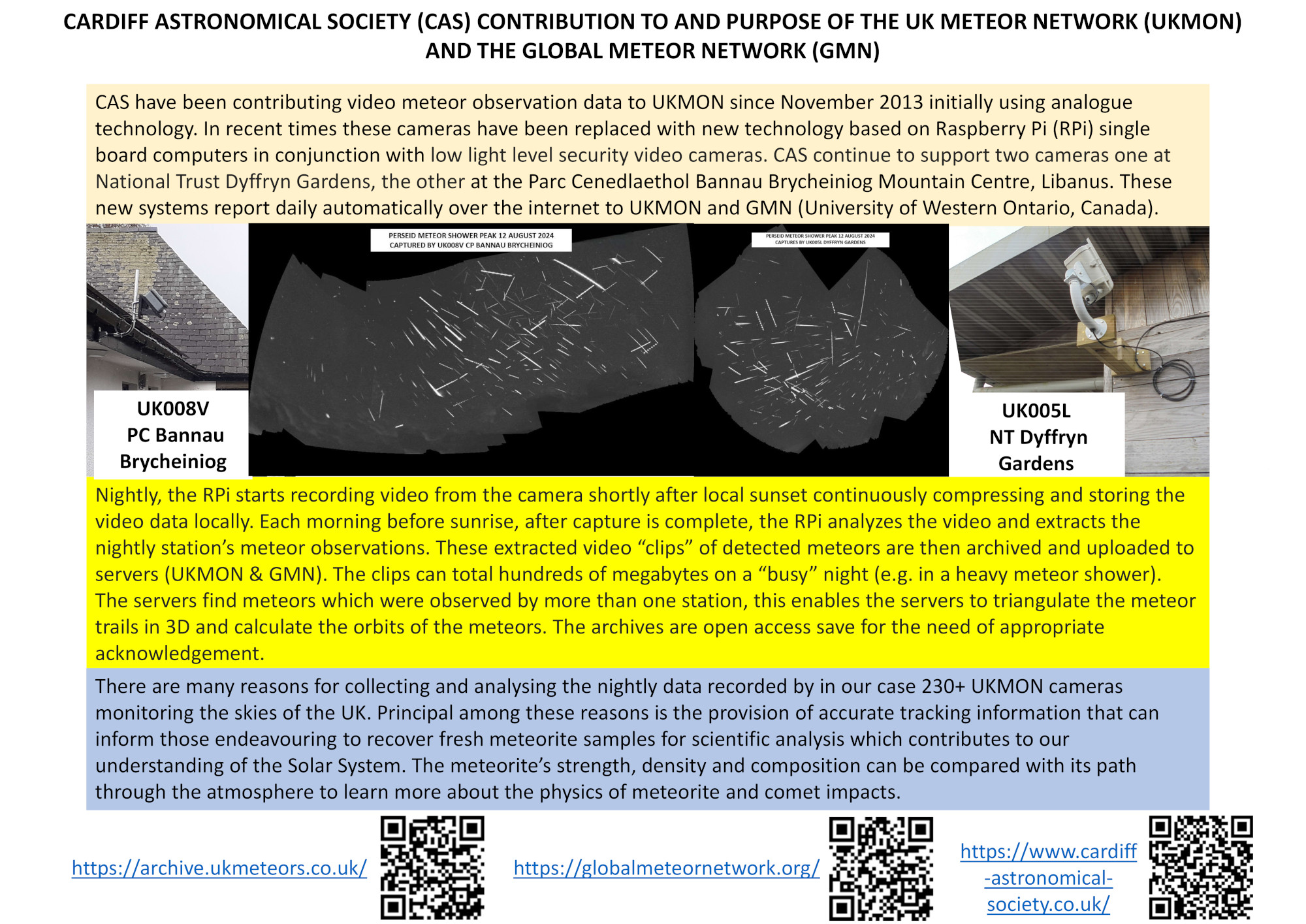
Cardiff Astronomical Society (CAS) have been recording meteor, sprite and fireball events since joining the United Kingdom Meteor Observation Network (UKMON) in November 2013.
UKMON was set up in early 2012 with the aim of it becoming the first UK-wide network using CCTV cameras to capture meteor trails across night sky and the following objectives:
- Establish a network of relatively cheap CCTV cameras to monitor continuously meteor activity over the UK;
- Assist members with analysis of meteor data and publishing papers;
- Enable members to contribute to, and collaborate with, other networks across Europe using video data acquisition technology;
- Bring together individuals who are already working independently;
- Encourage involvement by individuals and organizations (including astronomy societies, schools and colleges);
- Provide a platform for sharing knowledge and experience.
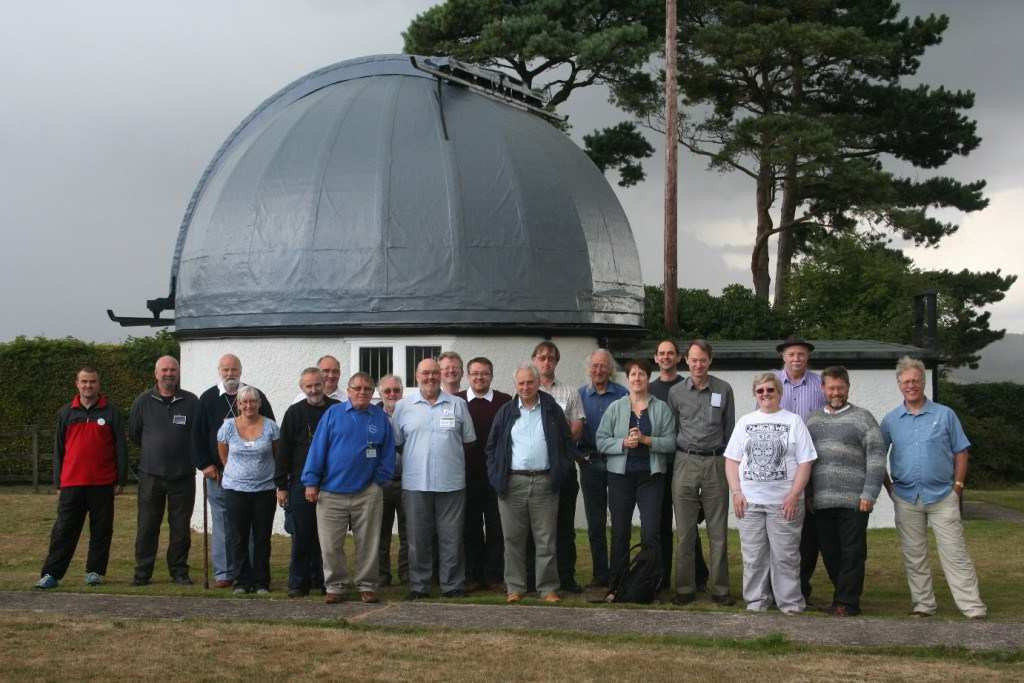
In September 2013 UKMON members from across the South of England and South Wales came together for the first time in an informal gathering held at the Norman Locker Observatory, Sidmouth.
Over 20 people attended the event from Hampshire AG, the NLO Solar, Planetary and Meteor Detection Group, Cardiff AS, Newbury AS, and Farnham AS. Bob Love & Claude Vallee from CAS were captured by the camera.
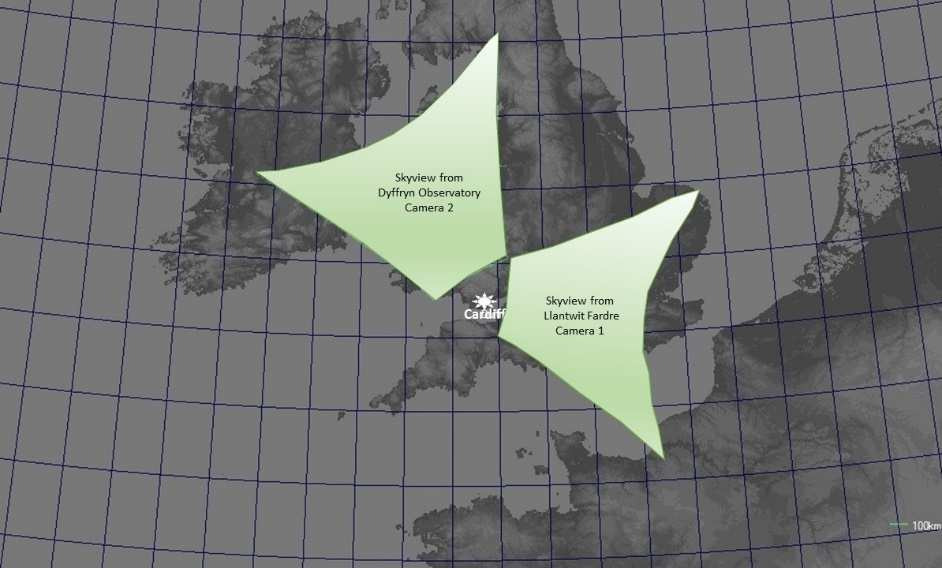
CAS have two static cameras in operation each with a different direction of view, the different direction of view is important to link in with the rest of the camera network operated under the UKMON banner.
CAS Camera 1 is located at Llantwit Fardre under the supervision of Martin Chick, the axis of the field of view is to the East. I look after CAS Camera 2 which is located at the CAS Observatory in Dyffryn Gardens, the axis of the field of view is to the North West.
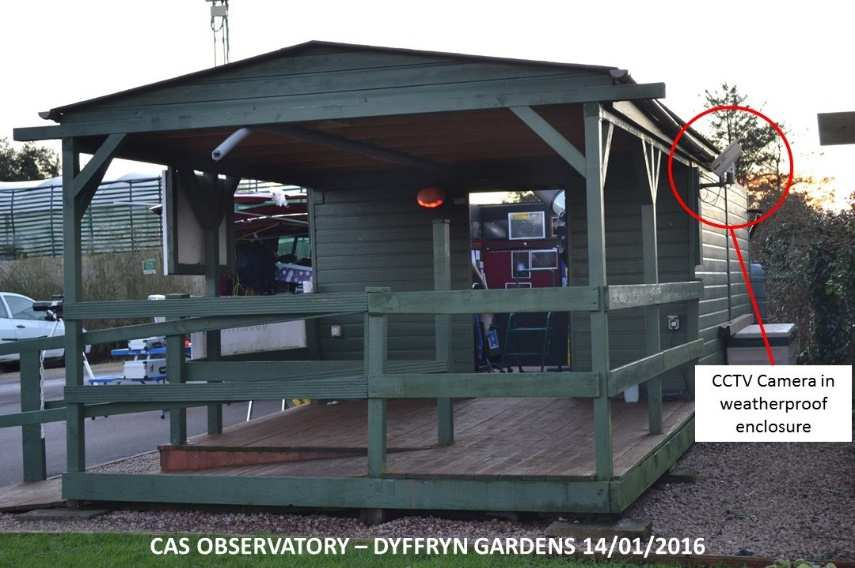
14 Jan 2016
The installation at the CAS Observatory consists of a CCTV camera in a weatherproof enclosure connected via a video decoder to a standard PC with a large hard drive for data storage. The PC is powered via an Uninterruptable Power Supply to try to protect the system from power outages. The PC has an application (UFOCapture) which is a motion detection program that scans the video stream for moving objects and when an object is detected, UFOCapture developed by SonotaCo in Japan writes a short AVI (movie clip) sequence to the computer hard disk.
With a remote acquisition station, the data is transferred monthly for further analysis. There are a number of steps to be completed before the processed data is uploaded to a central database maintained by UKMON where the data can then be integrated with the observations from other stations.
Typically, the raw data is scanned and edited by eye to remove events that are evidently not natural events such as planes, helicopters, birds, insects and even laser pens used at Stargazing events. Once this reduction has been completed an image is selected which has a good selection of stars visible, using this image there is an iterative process conducted within UFOAnalyser to confirm the orientation of the camera using the stars to confirm alignment. The next step is to process a batch (one month’s data) of AVI files. This will determine the types of event recorded, performs photometric and astrometric analysis to determine meteor properties and, if applicable, associates the meteor with a particular shower.
Within this data there will be some events (too faint, too bright, too slow or just in view) which cannot be automatically identified and hence could not be categorised by the automatic process; for this data it is necessary to apply a manual approach to provide some assistance/guidance to the processing software.
Having completed the processing, the data is then uploaded to the central database.
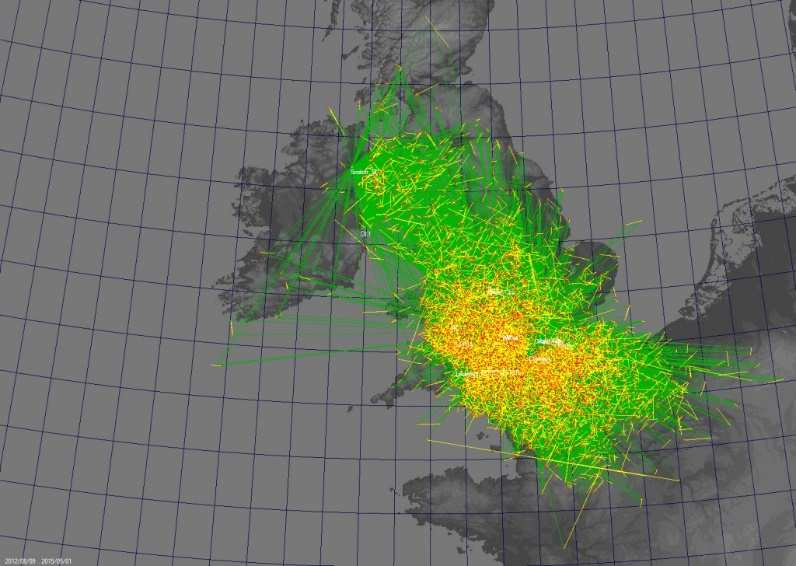
In May 2013 Richard Kacerek of UKMON reported that 50,000 meteors had been added to the UKMON worldwide catalogue by the 19 members and 24 cameras across the United Kingdom.
Reference to the ‘News and Updates’ blog at ukmeteornetwork.org/news-and-updates will give insight into some of the more significant United Kingdom meteor events since 2012.